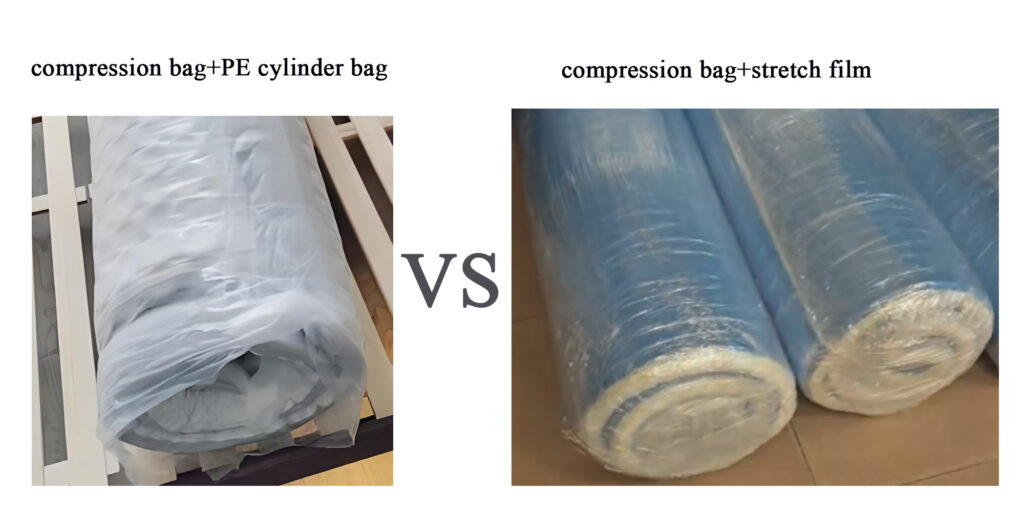
When packaging compressed pure foam mattresses, which method is less likely to result in the package bursting during transit: a compression bag combined with a rigid sleeve/bag (barrel-style), or a compression bag combined with stretch wrap (industrial cling film)?
Conclusion: The compression bag + rigid sleeve/bag combination is less prone to bursting than the compression bag + stretch wrap combination, particularly in scenarios involving long-distance transport, high temperatures, or high-density foam mattresses.
I. Fundamental Differences Between the Two Structures
• Compression Bag + Stretch Wrap (Industrial Cling Film)
◦ Inner layer: Vacuum compression bag (PA+PE).
◦ Outer layer: LLDPE stretch wrap; relies on wrapping tension to hold the shape; lacks rigid support.
◦ Advantages: Low cost, lightweight, form-fitting, space-efficient.
◦ Weaknesses: Resistance to internal pressure relies entirely on wrapping tension; corners and valve areas are prone to bursting; prone to “bulging leading to bursting” during high-temperature expansion.
• Compression Bag + Rigid Sleeve/Bag (Cylindrical or Rectangular Rigid Plastic Bag)
◦ Inner layer: Same vacuum compression bag.
◦ Outer layer: Thickened PE/PP rigid sleeve (tubular); acts like a “rigid exoskeleton” to restrict radial expansion.
◦ Advantages:
1. Strong rigid constraint: The rigid sleeve tightly contains the inner bag, offering superior burst resistance.
2. Even force distribution: No uneven tension from wrapping; corners are less likely to tear.
3. Better temperature resistance: The rigid sleeve deforms far less than stretch wrap at high temperatures, minimizing bulging.
◦ Disadvantages: Slightly more expensive, thicker material, and larger overall volume (though still much smaller than an uncompressed mattress).
II. Comparison of Burst Risks (Pure Foam Mattresses)
• Compression Bag + Stretch Wrap:
◦ Short-distance (<7 days) or soft foam: Low risk.
◦ Long-distance, high temperatures, or high-density firm foam: Medium to high risk (bulging, corner splitting, valve air leaks).
• Compression Bag + Rigid Sleeve/Bag:
◦ Any condition: Extremely low risk.
◦ High-density firm foam + summer shipping containers: The safest choice. III. Practical Factory Applications
• Low-end domestic sales/short-distance transport: Compression bag + manual stretch film wrapping (lowest cost).
• Mid-range exports/standard products: Compression bag + machine stretch film wrapping (uniform and tight).
• High-end/long-distance sea freight/high-density foam: Compression bag + tubular bag (plus end sealing + outer carton/woven bag); preventing bag bursting is the top priority.
IV. How to Choose (Direct Recommendations)
• If you are dealing with pure foam mattresses, focusing on exports, and are concerned about bags bursting during sea freight:
✅ Preferred: Compression bag + tubular bag (most reliable).
✅ Alternative: Compression bag + machine stretch film (lower cost, but keep the compression ratio at ≤1/4 of the original thickness—do not compress to the absolute limit).
In short: Choose tubular bags to prevent bursting; choose stretch film to save money on short-distance transport.